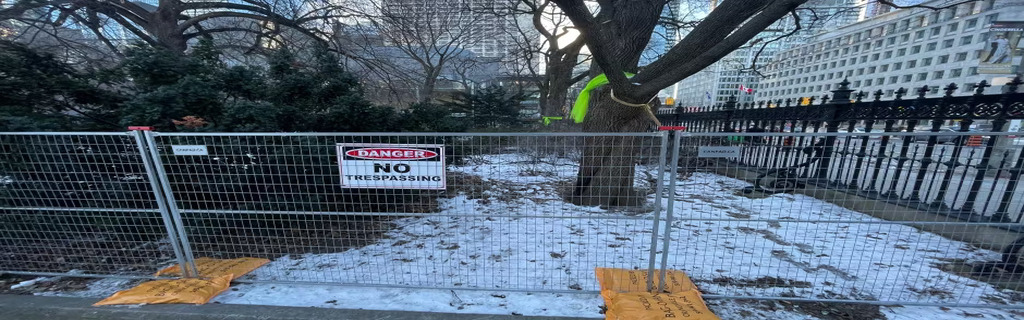
Akin to James Cameron’s epic Avatar movie premised on the battle between the human military and the Na’vi who fight to protect the destruction of their sacred willow like Tree of Souls. Those of us in the legal profession could certainly draw a comparison to the destruction of the mature trees nestled on the grounds of Osgoode Hall which is home to both the Law Society of Ontario (LSO) and the Ontario Court of Appeal.
As many may not be aware however, like Cameron’s blockbuster Avatar movie, lawyers, professors, the Law Society of Ontario, and other interested groups have also been battling a legal war to protect the integrity of this historic site to prevent the destruction of a dozen trees that surround the grounds. Although, lawyers, professors, the Law Society of Ontario, and many other interested groups argued for a permanent injunction against the TTC subway construction of what some have deemed an inappropriate transit pavilion, regrettably the battle was recently lost.
The LSO argued for the preservation of the trees in recognition of “the historic importance of preserving the grounds of Osgoode Hall for future generations” and “to ensure that the integrity of the Osgoode Hall building and its foundation are not compromised.”
Regrettably, the Law Society of Ontario lost their fight with the recent ruling by the Ontario Superior Court of Justice (OSCJ) which denied the Law Society’s request for a permanent injunction preventing the cutting down of a dozen mature trees of various species on the historic site and the removal of the historic iron fence.
Justice Hackland made the ruling in favour of the province’s transportation agency. An argument presented by the LSO under section 33 of the Ontario Heritage Act was that the buildings, lands, trees and surrounding fencing were indivisible and that heritage beauty and historic value should not be compromised. Section 33 of the Ontario Heritage Act states that no property owner can alter property if it is likely to affect the property’s heritage attributes. Notably, the site has multiple owners, being the Law Society of Ontario, Metrolinx, and the Ontario Government. The LSO argued that it had the right to restrict Metrolinx, the provincial agency tasked with various TTC expansion projects, under that legislation, which it argued applied to an indivisible heritage site with multiple owners.
The ruling will have an undeniable adverse heritage impact. Chris Borgal, an architect hired by the LSO, indicated that the proposed design would not be consistent with the aesthetics of the original building and site and that cutting down these trees and the construction of the transit pavilion at Toronto’s venerable Osgoode Hall would be tantamount to “drawing a cartoon in the corner of a painting done by a great master”. In Borgal’s opinion the site is indivisible and cannot be parcelled out without adversely impacting the integrity of the site as a whole. He eloquently stated that “Osgoode Hall is more than an old building or a green park in the centre of the city… it should be held to be sacred in the civil realm and owed due consideration for its importance as a landmark” and would cause permanent damage to one of the most historic sites in Canada that has been a symbol of justice in Ontario.
However as Justice Hackland explained, “the trees are the dominant feature of the grounds and have been the greatest source of garden expenses for the Law Society. Contrary to popular belief, few if any of the trees go back further than World War Two, and there has been a lot of turnover over the years. Life is hard for city trees. Many of our trees, including the lindens, honey locusts, and flowering crab apples, date from 1965, and as time goes on, the tree cover will continue to change.
It is an interesting legal, environmental, and historic issue, which has yet to be fully untangled like the roots of the dozen destroyed trees.
Full text of the decisions:
Law Society of Ontario v. Metrolinx, 2023 ONSC 1169
Haudenosaunee Development Institute v. Metrolinx, 2023 ONSC 1170 (CanLII)
Development Institute v. Metrolinx, 2023 ONSC 1170 (CanLII)